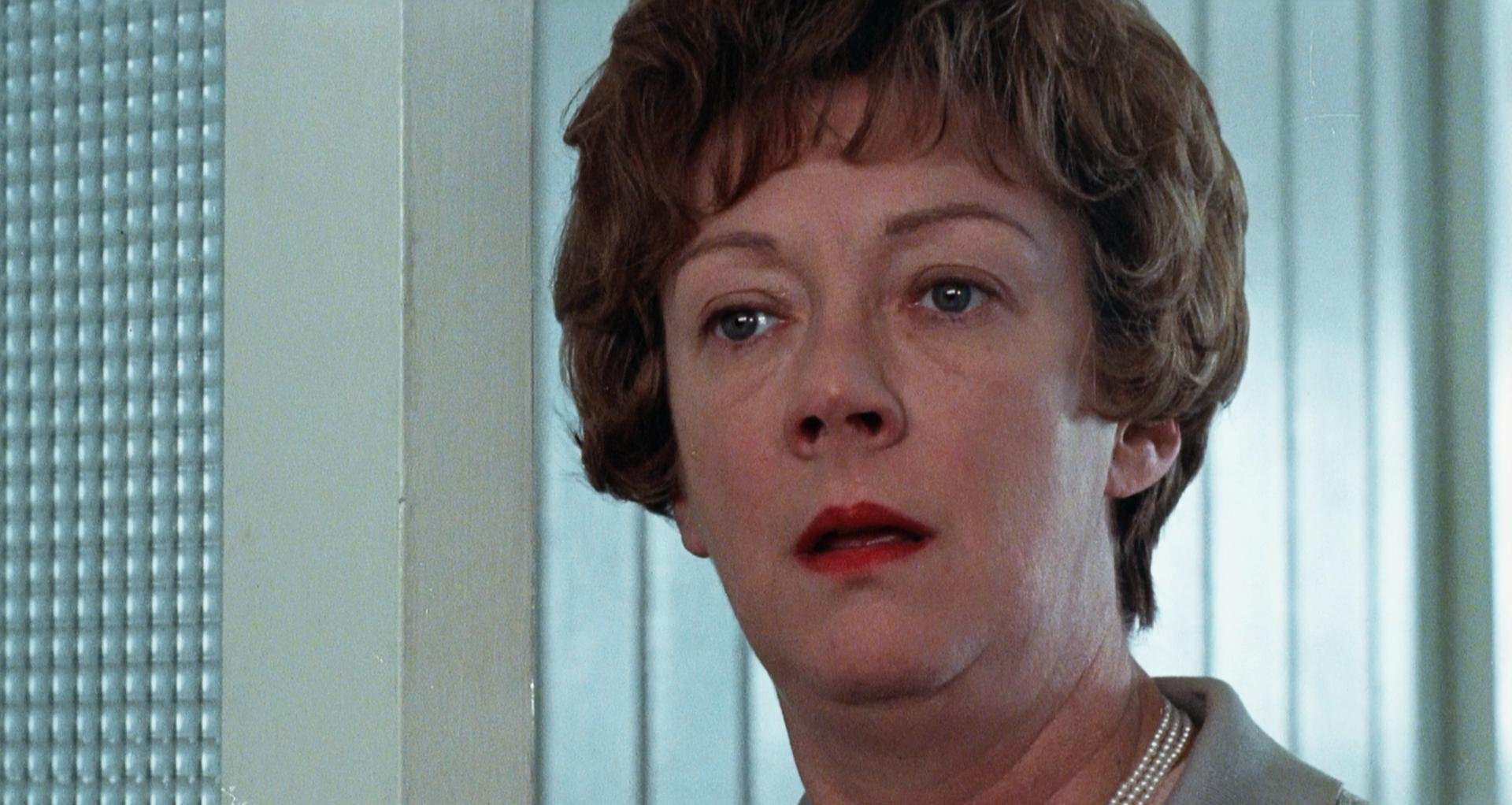
Magee was born as Patrick George McGee on 31st March 1922 in Armagh, County Armagh, Northern Ireland. He was the first of five siblings and was educated at St Patrick’s Grammar School in Armagh where he excelled in a number of school productions. With his low gravelly voice, tormented mad eyes, slightly stooped stocky frame, unkempt hair and unique pronunciation and intonation he would specialise in playing obtuse, disturbing, sadistic or oddball characters in a career that started in the late 1940s and lasted until his death in 1982 from a heart attack, aged just sixty years old. During this time he would become closely associated with the works of playwrights Harold Pinter and Samuel Beckett and earn a reputation as a hell raising heavy drinker and gambler. It seems that Magee had little quality control over the film roles he took later in his career, appearing in everything from films by auteur Stanley Kubrick and Italian schlockmeister Lucio Fulci to works by Joseph Losey and Roger Corman. Above all Magee was a passionate lover of theatre and the money he earned from taking film roles was often channelled into funding his own theatre productions.
Magee changed his stage name to supposedly avoid confusion with another actor called Patrick McGee. He was given to exaggeration in interviews and often stated that he was originally a street fighter from Dublin when in fact he was born into a comfortable middle class family. His father, Pat McGee, was the Master of Banbrook School. Magee joined the Belfast Group Players theatre group in 1948 and appeared in several acclaimed production during the three years he stayed there. He left to travel to England under the auspices of the renowned director Tyrone Guthrie to appear in a series of Irish plays staged at the Hammersmith Lyric as part of the Festival of Britain in 1951. He returned to Ireland with a tour of Shakespeare productions. Part of the acting company was the aspiring actor Harold Pinter who would strike up a lifelong friendship with Magee.

Magee returned to the UK to work in repertory theatre and soon picked up the occasional role on television. His debut in the TV medium came with the role of Harry Berks in the
BBC Sunday Night Theatre episode 'The Adventurer' (31st July 1955). He later returned to the anthology series with appearances in the episodes 'Juno and the Paycock' (17th March 1957), an Irish based family drama, and in a small role as a policeman in 'Teru' (4th August 1957). He would later return to the BBC series for two further instalments; 'Gracie' (12th October 1958) and 'Mooney’s Wreck' (3rd May 1959). Magee also found himself cast regularly in ITV’s flagship drama anthology series,
ITV Television Playhouse, with the role of Maguire in 'The Shadow of the Gun Man' (11th July 1957) based on the Sean O’Casey play, portraying Mate in a version of the Herb Tank play 'Longitude 49' (17th July 1959) and as a unnamed police detective in 'Who’s Owen Stephens..?' (10th November 1960). His final appearance in the programme was in the episode 'Too Old For Donkeys' (4th April 1963).
Magee met the writer Samuel Beckett in 1957 and was soon recording excerpts from Beckett’s novel Molloy and the short story From an Abandoned Work for transmission on BBC radio. Beckett was impressed with the quality of Magee’s voice and set about writing
Krapp’s Last Tape[1] especially for the actor. The play was first presented at London’s Royal Court Theatre in October 1958 with Magee starring as an aged misanthrope who listens to recordings of his former self with increasing intensity. The relationship between Magee and Beckett continued to flourish and Magee would later appear as Hamm in the play
Endgame (1964) presented the RSC at Aldwych in July 1964. In 1958 Magee married Belle Sherry and in February 1961 they became the parents of fraternal twins – Mark and Caroline.
His television career continued to bloom. For the crime drama series Dial 999 Magee appeared as Parsons in the episode 'The Great Gold Robbery' (1959) and as Michael Davitt in the ITV Play of the Week episode 'Parnell' (10th February 1959), a political drama based on the life and times or the Irish politician Charles Stewart Parnell. Next was the BBC Sunday Night Theatre play 'Mooney’s Wreck' (3rd May 1959). On stage he took on the role of Max in the Kenneth Jupp play The Buskers during March 1959. Later the same year he appeared as the aptly named Father Domineer in the English Stage Company production of Cock-A-Doodle Dandy by Sean O’Casey during September and October 1959, Having established the part of Ulrich Brendel in the English Stage Company’s production of Rosmersholm during October 1959 Magee retired from the role which was taken over by Alan Dobie when it transferred from the Royal Court to the Comedy Theatre in January 1960.

The first year of the new decade would see Magee making television appearances in an episode of Deadline Midnight (25th July 1960) and playing the character Jason in the BBC thriller series Here Lies Miss Sabry (8th August – 12th September 1960). His final television appearances for the year were in the BBC Sunday Night Play production 'The Ruffians' (9th October 1960) and Philip Broadley’s Associated Rediffusion play Owen Stephens (11th November 1960). Magee played a police man doggedly pursuing two men who have stolen a small fortune from a local business. He made a suitable film debut as the dour chief prison warden Barrows in Joseph Losey’s film The Criminal (1960) opposite Stanley Baker and Sam Wannamaker. This was followed by the role of Paddy Flynn, a drunken bully, in the crime drama Rag Doll AKA Young, Willing and Eager (1961) and appearing as Ben Black in the Edgar Wallace thriller Never Back Losers (1961).
His TV appearances for 1961 took in an episode of No Hiding Place – 'Explosion Underground' (30th June 1961) and playing a lawyer in 'Inquest at Golgotha' (1st October 1961) an episode of the ATV production About Religion. He ended the year with by appearing in a rare science fiction flavoured episode of Armchair Theatre – 'Murder Club' (3rd December 1961). He was equally busy in stage with A Whistle In The Dark at the Royal theatre, Stratford during September 1961. The play, authored by Thomas Murphey, was written as an entry to an all-Ireland amateur drama competition two years previously, but was held back on the grounds that the content was too controversial ever to be presented in the theatre. Also in the cast were Derren Nesbitt, Michael Craig and Dudley Sutton.
The start of 1962 saw Magee appear in 'Stab in the Dark' (23rd January 1962), the fourth episode of the new police drama series
Z Cars, as the character Mr O’Conor. He popped up in an uncredited role as Mr Lee in the film
The Boys (1962) and could be seen as RSM Hicks in
A Prize of Arms (1962). Back on TV he made his second appearance in an episode of the
ITV Play of the Week taking the central role of lighthouse keeper Duncan Bishop in the comedy drama 'Miracle on Mano' (14th August 1962). His next TV appearance was in the second episode of a dramatization of Sophocles'
Antigone (16th October 1962) in the role of Teiresias.

The following year, 1963, would his busiest period yet for film and television jobs. His film appearances for the year featured work with the director Roger Corman on The Young Racers (1963), playing Sir William Dragonet, and the role of Inspector Cummins in Ricochet (1963), an Edgar Wallace potboiler. He had a supporting role in the thriller The Very Edge (1963) which was filmed in his native Ireland along with proto-slasher Dementia 13 (1963), Francis Ford Coppola’s first film as a director. Magee appeared as Justin Caleb in the horror thriller which was funded by Roger Corman. Magee joined a largely Yugoslavian cast for Operation Titian (1963) playing Doctor Morisijus, with Corman again providing financial backing. The film has a complex history with Corman repackaging and re-editing the film for television where it played as Portrait in Terror. However, Corman was still unsatisfied with the results and so hired director Jack Hill to film some new sequences. This version was released as Blood Bath (1966). This version was sold again to television with further scenes added by another director and became known as Track of the Vampire. Magee’s major film role during 1963 was as Bishop in a restaurant in the Joseph Losey film The Servant (1963) which was headlined by James Fox and Dork Bogarde. This was his second film for Losey.

The actor was equally as busy with television roles during 1963 appearing in 'The Escape' (20th June 1963), an episode of the adventure series
Moonstrike,
Zero One episode 'Stopover' (21st August 1963) as the character Gallegos and playing a police inspector in 'Express Delivery' (12th October 1963), an episode of
The Sentimental Agent. He also popped up in two episodes of the soap opera
Compact playing the character Sligo in the episodes 'Faith and Begorra' (10th September 1963) and 'A Touch of the Blarney' (12th September 1963). There was also two appearances in
The Avengers; playing Pancho in the second season instalment 'Killer Whale' (2nd March 1963) and the third season story 'The Gilded Cage' (9th November 1963) as criminal mastermind J P Spagge. Finally he appeared as William Breen in
The Plane Makers episode 'The Old Boy Network' (21st October 1963) which was followed by his return in the later episode 'The Smiler' (14th January 1964).
More high profile film work came with the role of surgeon James Reynolds in the classic
Zulu (1964), Alfredo in the sumptuous looking Roger Corman production of
The Masque of Red Death (1964) and as Inspector Walsh in Bryan Forbe’s
Séance on a Wet Afternoon (1964). His TV resume for the year included playing Jack Mullen in two episodes of
Z Cars written by Eric Paice – 'The Fire Raiser' (21st March 1964) and 'The Witness' (28th March 1964) – and playing The Duke of Wellington for the
Theatre 625 episode 'Carried By Storm' (25th October 1964) directed by Donald McWhinnie who would later direct 'What Big Eyes'.
The Stage review singled out his performance in the play “Patrick Magee showed us yet another side of his considerable talent, and was indeed the Iron Duke when he delivered lines like “The only rules of war that concern is gentlemen. Are mine.
[2]””
Magee joined the Royal Shakespeare Company in 1964 following a request from Harold Pinter who wanted Magee to appear in a revival of
The Birthday Party, with Pinter directing, at the Aldwych theatre during June 1964. Magee played the role of the torturer McCann. Further RSC roles included the role of Roche in another revival,
Afore Night Come by David Rudkin, during July. August saw a legendary production of
The Persecution and Assassination of Marat as Performed By The Inmates of The Asylum of Charenton Under The Direction of the Marquis de Sade. Magee was the Marquis de Sade. After a successful run in London the play transferred to New York to much praise including Magee winning a Tony Award for Best Performance by a Featured Actor in a Play in 1966 for his portrayal. This would lead to international recognition and enable Magee to go from B to A class budget films in due course.
Magee was so busy with the RSC that he only found time to make two television appearances in 1965; essaying the role of James Spalding in 'Beware of the Dog' (16th May 1965), an episode of
Dr Finlay’s Casebook, and featuring as Tetzel in the
BBC Play of the Month production 'Luther' (19th October 1965). Film wise he appeared as a police surgeon on the British horror flick
The Skull (1965) and could be seen as Doctor Henderson in
Die, Monster, Die! AKA
Monster of Terror (1965) which was based on the H P Lovecraft story
The Colour Out of Space. Magee also played a criminal out to steal a valuable painting in
Portrait in Terror (1965).
Magee made no film or TV appearances during 1966 due to his stage commitments including Marat/Sade and various prestigious RSC and Broadway productions. He would recreate his Tony Award winning performance as the Marquis de Sade in the cinema production of Marat/Sade (1967). One of his only two TV roles during this period was as Mephistophilis in a production of 'Doctor Faustus' (27th January 1967) made for the ATV educational programme Conflict. This series was hosted by John Gielgud and presented scenes from classic dramas especially adapted for schools and colleges. Magee’s other television role was in the Dennis Potter production Message for Posterity (3rd May 1967), as the elderly painter James Player, who is commissioned to paint a portrait of the former Conservative Prime Minister Sir David Browning played by Joseph O’Connor.
He had a handful of television roles the following year; appearing as an old man in the two-handed play 'A Private Place' (3rd January 1968) for Thirty Minute Theatre, playing Arnold Jessie in The Wednesday Play instalment 'Nothing Will Be The Same' (6th November 1968) opposite 'Murrain' star Bernard Lee, appearing as Pedraza in The Champions story 'The Iron Man' (20th November 1968) and undertaking the part of Philo in 'Neutral Ground' (2nd December 1968) a play by Tom Stoppard for the ITV Playhouse series directed by Piers Haggard, who would later helm the final Quatermass TV series. The play was based on the classical Greek legend of the warrior Philoctetes updated to a 1960s Central European spy story. Magee featured as a double-crossed and abandoned secret agent. Film work for 1968 included General Starkey in the war film Battle For Anzio (1968), playing a lunatic prisoner in the comedy film Decline and Fall…of a Bird Watcher (1968) and revisiting his stage role as Shamus McCann, one of the evil tormentors of Robert Shaw’s character in William Friedkin’s film version of the Harold Pinter play The Birthday Party (1968).

Magee continued to be busy with his preferred platform for acting in the theatre and so in 1969 he had only a handful of film or television credits. His only film appearance for the year was to add some flavour as the character Alexi to the otherwise bland thriller
Hard Contract (1969), a vehicle for James Coburn and Lee Remick. He also made the TV movie
Destiny of a Spy (1969) which was headlined by Lorne Greene and Anthony Quayle. His TV appearance for the year was in an episode of the BBC’s
The Canterbury Tales which adapted the works of Chaucer. Magee could be seen as an old man in 'The Pardoner’s Tale' (13th November 1969).
The following year Magee played the role of Mark in the Peter Shaffer play
The Battle of Shrivings at the Brighton Royal during January with a London run in February 1970. Mark sounds typical Magee material from
The Stage review description of his character as a “raging, coarse, earthy force of destruction
[3]”. As well as the legends of stage John Gielgud and Wendy Hiller in the cast there was a young actor just making his mark, Martin Shaw, who would later play a lead role in the
Beasts episode 'Buddyboy'. The first year of the new decade saw Magee make only two film appearance with the role of Hugh Peters in
Cromwell (1970) and as General Ataturk in the action comedy
You Can’t Win ‘Em All (1970). His non-stage work for 1971 consisted of three film roles the first of which was for director Peter Brook’s version of
King Lear (1971) playing the role of Cornwall. The next was in the obscure historical epic
The Trojan Woman (1971) undertaking the role of Menelaus. The final film role for the year is possibly one of his most famous, playing Mr Alexander, the householder who tortures Malcom McDowell’s character Alex in Stanley Kubrick’s
A Clockwork Orange (1971) after his home is invaded by Alex. McDowell and Magee had previously met when they had worked on the 1965 Royal Shakespeare Company production
Squire Puntila and His Servant Matti. Magee had the lead role of Matti and McDowell was a lowly supporting artist.

1972 would be the year that Magee really threw himself into horror film roles starting with the portmanteau Tales From The Crypt (1972). Magee featured in the segment 'Blind Alleys' playing the role of George Carter, the leader of a group of blind people who have their revenge on the callous new owner of their care home. He also took the lead role of the sinister unnamed minister who leads a religious sect called The Brethren in Robert Hartford-Davis’ grubby horror flick The Fiend AKA Beware My Brethren (1972). Next was another portmanteau horror, Asylum (1972), with Magee essaying the role of the distinctly odd Doctor Rutherford who instructs a new doctor (Robert Powell) that he must guest which one of four inmates is the doctor he has come to replace. This acts as the framing story for the portmanteau film. His final horror film for the year was the Hammer production Demons of the Mind (1972) in which he chews the scenery as Falkenberg. His other film appearances for the year included appearing as General Bindon Blood in Young Winston (1972) and as an elderly monk in Pope Joan (1972). He also made two appearances in two editions of Thirty Minute Theatre, the first was as Michael in 'Thrills Galore' (4th September 1972), whilst his second was in a performance of 'Krapp’s Last Tape' (29th November 1972).
Magee had a guest role as Gardner in The Persuaders episode 'Chase' (2nd March 1973) before appearing in the Orson Welles’ Great Mysteries adaptation of 'The Monkey’s Paw' (10th November 1973) playing the central role of Sergeant Morris. Also in the cast was Michael Kitchen who would later appear alongside Magee in the Beasts episode 'What Big Eyes'. Magee then made his second appearance in a BBC Play of the Month production playing The Storyteller in an adaptation of Brecht’s play 'Caucasian Chalk Circle' (16th May 1973). His film credits included another horror film, And Now The Screaming Starts (1973) playing Doctor Whittle, the Donald Sutherland starring crime thriller Lady Ice (1973) and the truly bonkers psychedelic science fiction film The Final Programme AKA The Last Days of Man on Earth (1973) as mad scientist Doctor Baxter.

Film roles for 1974 took in in the Italian drama
Simona (1974) and
Luther (1974), a film version of the John Osborne stage play, starring Stacey Keach as Martin Luther supported by a wealth of Brit character actors including Hugh Griffith, Julian Glover, Judi Dench and Robert Stephens. Television roles included playing Corporal Donovan in 'The Last Charge' (3rd March 1974), a second season episode of
The Adventures of Black Beauty. His major television role for the year was undertaking the title role in a Thames Television production of
King Lear (24th September – 5th November 1974). This was a six-part production for schools and colleges and originally transmitted on Tuesday mornings from 24th September. The adaptation, intended for secondary school pupils boasted a cast that also had roles essayed by Patrick Mower (Edmund), Peter Jeffrey (Cornwall) and Wendy Allnut (Cordelia). The production was later edited into a single play running to two hours in length and was released on DVD in 2004. In the year prior to his role in
Beasts Magee played Cardinal Bellarim in the biopic
Galileo (1975) which saw him reunited with director Joseph Losey. Rather strangely Topol was cast as the eponymous 17th Century Italian astronomer. His only other film role for the year saw him also reunited with Stanley Kubrick for whom he undertook the role of gambler the Chevalier du Balibari in
Barry Lyndon (1975). During the filming a card game scene Magee had difficulty in saying his lines due to being distracted by having to wear an eye patch. When he did get the line right his hands were not in the position that Kubrick required and so a hand model was used to shuffle and deal the cards. However this caused continuity problems because the hand model had smooth hands and Magee’s were very hairy. Kubrick’s solution to match the shots was for Magee to shave his hands.
On television he could be seen playing another mad scientist, Professor Marcus Carnaby, in the
Thriller episode 'A Killer in Every Corner' (1st February 1975). Carnaby is a psychologist who habitually records his voice on a tape recorder, possibly a direct reference to
Krapp’s Last Tape. Next was a role as Vamvakaris in the
Quiller episode 'Mark The File Expendable' (7th November 1975). On the stage there was a revival of
Krapp’s Last Tape at the Greenwich Theatre during December 1975. Magee directed with Max Wall taking on the central role previously written by Beckett for Magee. During May 1976 to mark the seventieth birthday of Samuel Beckett the Royal Court staged a new production of his play Endgame, directed by Donald McWhinnie who would cast Magee in his episode of
Beasts. Magee played the central role of Hamm whilst a young Stephen Rea essayed Clov. This was followed with McWhinnie also directing a production of Beckett’s trilogy
Play, That Time and
Footfalls. Magee appeared in
That Time. Further stage roles for the year included
The White Devil at the Old Vic during July 1976 and part of the Oxford Theatre Festival Magee directed a revival of Samuel Beckett’s
Waiting For Godot during August.

Magee’s role as Leo Raymount in the Beasts episode 'What Big Eyes' was his only film or television appearance during 1976. Perhaps Magee’s biggest achievement of the year was not on the screen or on the stage, but in the realm of politics. He joined fellow actors Vanessa Redgrave and Glenda Jackson in successfully campaigning to persuade the actor’s union Equity to boycott South African because of Apartheid. Post-Beasts there was a third and final appearance in a BBC Play of the Month production with Magee in the supporting role of Fergus Crampton in a version of the George Bernard Shaw play 'You Can Never Tell' (30th October 1977). This was followed by a role in 'The Well' (12th December 1977), an episode of the BBC drama series Who Pays The Ferryman? His only film work for the year was as a Russian KGB officer, General Strelsky, in Don Siegel’s action film Telefon (1977) which starred Charles Bronson. During 1978 Magee’s sole television appearance was as the recurring character Ebenezer Balfour in HTV’s production of Kidnapped. He then appeared on screen in the strife-torn Belfast set Play for Today episode 'The Last Window Cleaner' (13th February 1979). Tony Harrison’s staging of Aeschylus trilogy of plays was filmed by the BBC and Magee could be seen in the role of Kalchas in the opening episode Agamemnon (7th March 1979). For the French film production Les soeurs Bronte (The Bronte Sisters) (1979) Magee played the strict Anglican pastor who fathered the eponymous siblings. Churchill and the Generals (1979) was a star studded TV movie which featured Timothy West as Churchill. The production examined the relationship Churchill had with his army generals during the war and Magee appeared as General Sir Archibald Wavell. Magee also appeared as Muldooney in the Play for Today production 'The Last Window Cleaner' (13th February 1979).
In the last few years of his life Magee became more active onscreen than he had been in recent years. In 1980 he appeared in four cinema releases; playing Ernst Mueller in heist movie
Rough Cut (1980), popping up as the sacrilegious Reverend Slodden who declares he is the anti-Christ in comedy vehicle
Sir Henry at Rawlinson’s End (1980), portraying the Marquis in obscure Swedish horror film
The Sleep of Death AKA
Inn of the Flying Dragon (1980) and a cameo as a priest in the low budget fantasy film
Hawk The Slayer (1980). His only TV role for the year was in a
Play for Today episode which unusually featured a science fiction storyline. 'The Flipside of Dominck Hide' (9th December 1980) featured Magee in the role of Caleb Line.
His appearance as the pompous aristocrat Lord Cadogan, head of the British Olympic Committee, in the Oscar winning film
Chariots of Fire (1981) is possibly his most recognisable role from his final years and is certainly the most highly visible with his other film roles for the year being in the horror genre.
The Monster Club (1981) was a late entry into the horror portmanteau field and feels and looks very old fashioned. Magee graced the film with his role as the Innkeeper in the third and final segment.
The Black Cat (1981) was an Italian horror film directed by the notorious director Lucio Fulci which featured Magee as Professor Robert Miles opposite David Warbeck’s police inspector and Mimsy Farmer. Professor Miles is a psychic who is able to communicate with his pet cat who he sends to wreak vengeance on those that wronged him. His final horror film role was as General William Danvers Carew in Walerian Borowczyk’s art porn horror
The Strange Case of Doctor Jekyll and Miss Osbourne (1981). The director had seen Magee in
Sir Henry at Rawlinson’s End and recruited him and the cinematographer, Martin Bell, to work on his production following the viewing. Magee’s final film appearance was in the documentary
Samuel Beckett: Silence To Silence (1982) which celebrated the work of the writer with who Magee had been a lifelong friend to.

Next was the role of Alfred in 'Horace Finds a Friend' (22nd April 1982), an episode of the Yorkshire Television comedy series
Horace starring Barry Jackson in the title role. His final posthumous appearance saw him reprise the role of Caleb Line in the
Play For Today story 'Another Flip For Dominick' (14th December 1982)
Despite all this success Magee still struggled financially, in part due to his vices. A low in his stage career came when he appeared opposite Helen Mirren in a production of the play
The Faith Healer at the Royal Court Theatre in London. Magee was cast in the central role of Frank McCabe and was eventually sacked for appearing on stage drunk. The playwright Thomas Kilroy who was rehearsing another production at the Royal Court reflected “I have never been so frightened in the theatre. Most of those nights Magee was so drunk that he barely made it into the spot on the stage. To compound matters, Mirren was giving a performance of matching power and you ached for even one respite to allow these two performances to speak to one another. It never quite happened because the real danger that Magee was about to fall head over heels into the front rows of the stalls.
[4]”
Magee died from a heart attack (probably caused by his drinking and hell raiser lifestyle) at his home in Fulham, London on 14th August 1982. His wife Belle passed away in September 2006. In 2017 his life was commemorated with a blue plaque by the Ulster History Circle at his former family home in Armagh. The plaque was unveiled by actor Stephen Rea who had appeared with Magee on stage in a 1976 production of Samuel Beckett’s
Endgame.
“Gielgud, Hiller, Magee in Shaffer Drama”, The Stage and Television Today, Thursday 29th January 1970, page 14
Quoted in “A Drunk, Gambler and Hell-Raiser, But A Towering Acting Talent… Remembering Patrick Magee” by Ivan Little, Belfast Telegraph Digital, available at https://www.belfasttelegraph.co.uk/entertainment/film-tv/news/a-drunk-gambler-and-hellraiser-but-a-towering-acting-talent-remembering-patrick-magee-35974861.html (accessed 19th March 2019)